Flight, ship, satellite and camera data are already public, scattered across a dozen feeds nobody has time to check separately. God's Eye View pulls them onto one photorealistic 3D globe you run locally, click-to-track any target, and talk to with voice. It opens with no account and no API key. Photorealistic 3D tiles need an optional paid key later, if you want them.
By Raj Singh · September 2026 · 25.7k stars · #1 on GitHub Trending, August 2026 · 6 min read
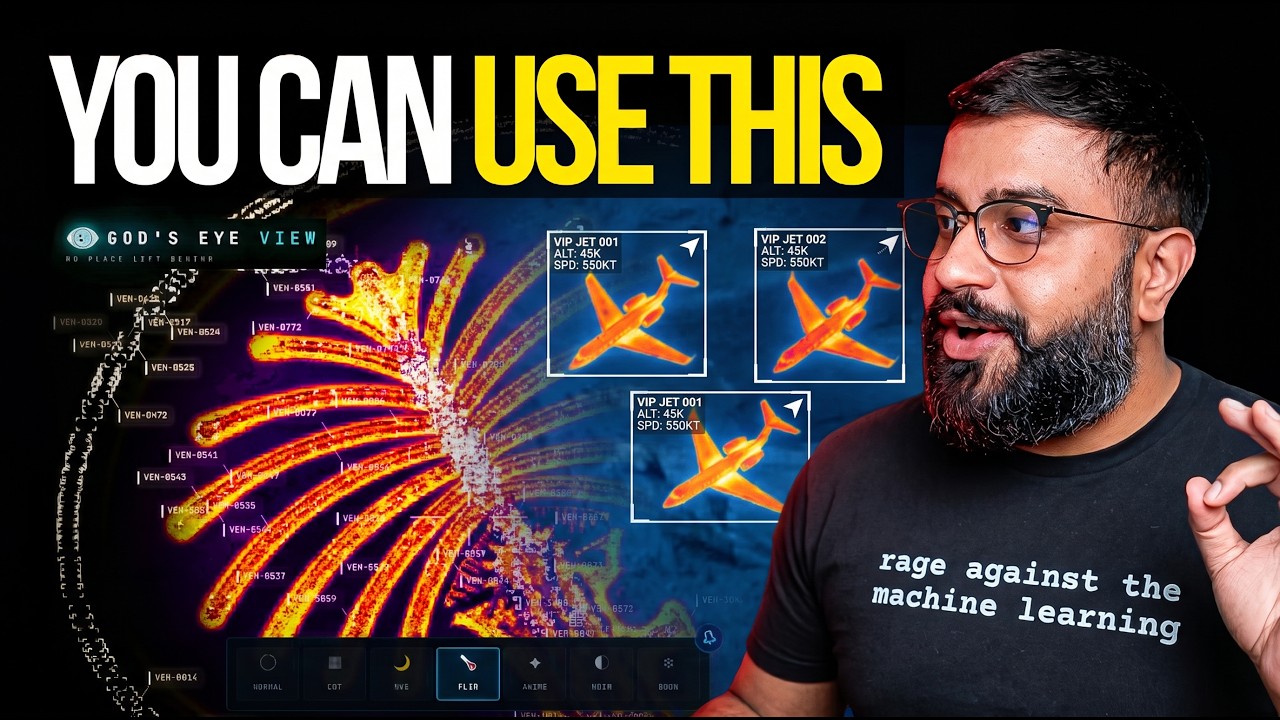
The globe on open, before you touch a key or an account: live aircraft as tracked contacts, a cockpit view you can drop into, and the tactical HUD overlay running on public data the whole time.

It opens with zero keys. Esri satellite imagery and keyless terrain load by default. Flights, military traffic, satellites, earthquakes, public cameras and radio all work before you touch the settings panel.
Two install paths, same app. Pinokio 8.2 or newer gives you a one-click install and start button on Windows, macOS or Linux. The terminal path needs Node 24.14 or newer, or 26.x, plus npm ci.
Traffic on roads is simulated. The README says it directly: road traffic is modeled along real roads from aggregate location data, not a live feed. CCTV camera poses and rocket trajectories are coarse estimates, not exact positions.
Photorealistic tiles cost extra. A Cesium ion token unlocks eligible personal, non-commercial 3D tiles for free. A metered Google Maps key is the direct, paid route with in-app place search. Provider quotas apply either way.
Licence, in plain English: MIT, declared in package.json. Free for commercial work, fine to fork or self-host, no obligation beyond keeping the licence file.
Drop your email and unlock the rest: what you need, the terminal install, the two keys worth adding and why, and what to do when a feed goes quiet.
One email. No follow-up unless I ship something that fits.
Clone it, install with the exact Node engine range in package.json, then run the setup doctor before the dev server. The doctor catches the Node-version mismatch before it becomes a confusing runtime error.
The install
npm run doctor exists because the engine range is exact: Node 24.14 to under 25, or 26 and up. A Node install outside that range is the single most common reason the dev server refuses to start.
The in-app POWER UP panel is the intended way to add keys, it writes .env for you. .env.example is the reference if you are running headless or self-hosted.
| Setting | Default | Why I change it |
|---|---|---|
| GOOGLE_MAPS_API_KEY | empty | Client-exposed by design, visible in devtools. Restrict it by HTTP referrer in Google Cloud before you set it, not after. |
| Cesium ion token | none | Free for personal non-commercial use and gets you photorealistic 3D without a metered bill. Add this before a paid Google key, not instead of trying keyless first. |
The interface rewards clicking around more than reading docs. Voice control is the one feature worth learning deliberately, since it is not obvious from the UI alone.
A tracked vessel or fire hands off to the nearest live public camera in one click, which is the feature that makes this feel like more than a map.
./scripts/dev-fresh.sh crashed under the stock Bash 3.2 that ships on macOS before v0.1.1. Update to v0.1.1 or newer if you hit that specifically.Nothing here writes to your machine outside the checkout. Deleting the folder removes the app and any .env you created inside it.
One clone, one optional key, and public flight, ship and camera data becomes one globe instead of a dozen tabs. Start keyless, add a Cesium token only once you actually want the photorealistic tiles.
↑ Unlocks the moment you submit the form above.
I'm Raj Singh, founder of DebtOps.ai and a Claude certified partner. Over the last five years I've managed $25M in ads, built AI solutions for Fortune 100 companies, and installed AI operating systems and AI brains inside small businesses. Everything here is something I've shipped, debugged, or watched a client ship. My goal with AgileSingh is to make you irreplaceable in this AI age.
Public feeds on a globe is one kind of live dashboard. The AI infrastructure stack guide covers the layer where your own product's data gets the same real-time treatment.